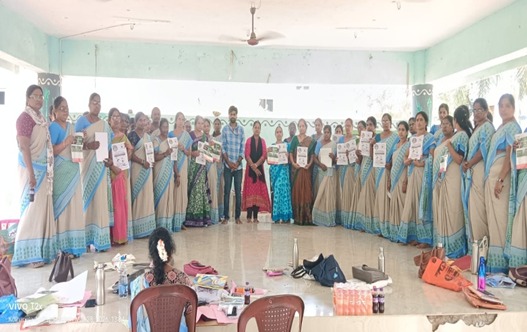
A training program on “Early Identification and Intervention for Anganwadi Workers (ICDS)” was successfully conducted on 28 March 2026 at the ICDS Divisional Office, Kothapeta, covering the Palivela and Kothapeta sectors. The program was organized by the People’s Action for Rural Awakening (PARA) under the leadership of Mr. Badugu Mahima Rao, CBR Coordinator, with the support of Manos Unidas. A total of 46 Anganwadi Teachers actively participated in the training, making it a significant capacity-building initiative at the grassroots level.
The primary objective of the program was to strengthen the knowledge and skills of Anganwadi Workers in the early identification of developmental delays and disabilities among children, particularly those below the age of three years. The training also aimed at improving their understanding of different types of disabilities and enhancing coordination between ICDS functionaries and voluntary organizations for better service delivery.
In his keynote address, Mr. Badugu Mahima Rao emphasized the critical importance of early identification and timely intervention. He explained that identifying developmental delays at an early stage can significantly reduce the long-term impact of disabilities and improve the overall quality of life of children. He elaborated on the various types of disabilities, the early signs and symptoms to be observed in children, and the simple methods and tools that can be used at the community level for early detection. His session provided practical insights that are directly applicable to the day-to-day work of Anganwadi Workers.
The technical session was facilitated by Ms. Badugu Subbayamma, who served as the resource person for the program. She delivered a detailed presentation on the government welfare schemes and pension provisions available for persons with disabilities. She also explained in depth the 21 categories of disabilities recognized under the Rights of Persons with Disabilities Act, 2016, enabling participants to better understand the legal framework and classification. Further, she guided the participants on the procedures to access these entitlements, and how they can support families in availing the benefits effectively.
Ms. Begam, ICDS Sector Supervisor, Ravulapalem, addressed the participants and highlighted the importance of adhering to government norms and guidelines in all processes related to child welfare. She stressed the need for strong coordination between Anganwadi Workers and organizations such as PARA and LAMP, which can help in ensuring timely support and services to children with developmental delays and disabilities. Her address reinforced the role of convergence in improving outcomes at the community level.
During the program, Mr. Prakash (DBTech), representing PARA, provided information on ongoing skill development initiatives offered by the organization. He shared details about training opportunities in Drone Technology and Solar Computing, encouraging participants to inform eligible beneficiaries and youth in their communities about these programs for enhancing livelihood opportunities.
The training program witnessed the active participation of all 46 Anganwadi Workers, along with ICDS supervisors and representatives from PARA and LAMP. The sessions were interactive and informative, allowing participants to engage, clarify doubts, and gain both theoretical knowledge and practical understanding relevant to their field responsibilities.
In conclusion, the program successfully reinforced the importance of early identification, timely intervention, and effective coordination among stakeholders. It strengthened the capacity of Anganwadi Workers by equipping them with essential knowledge and practical skills required to identify developmental delays and support children and their families. The training is expected to contribute significantly to improving service delivery and ensuring better developmental outcomes for children at the grassroots level.