
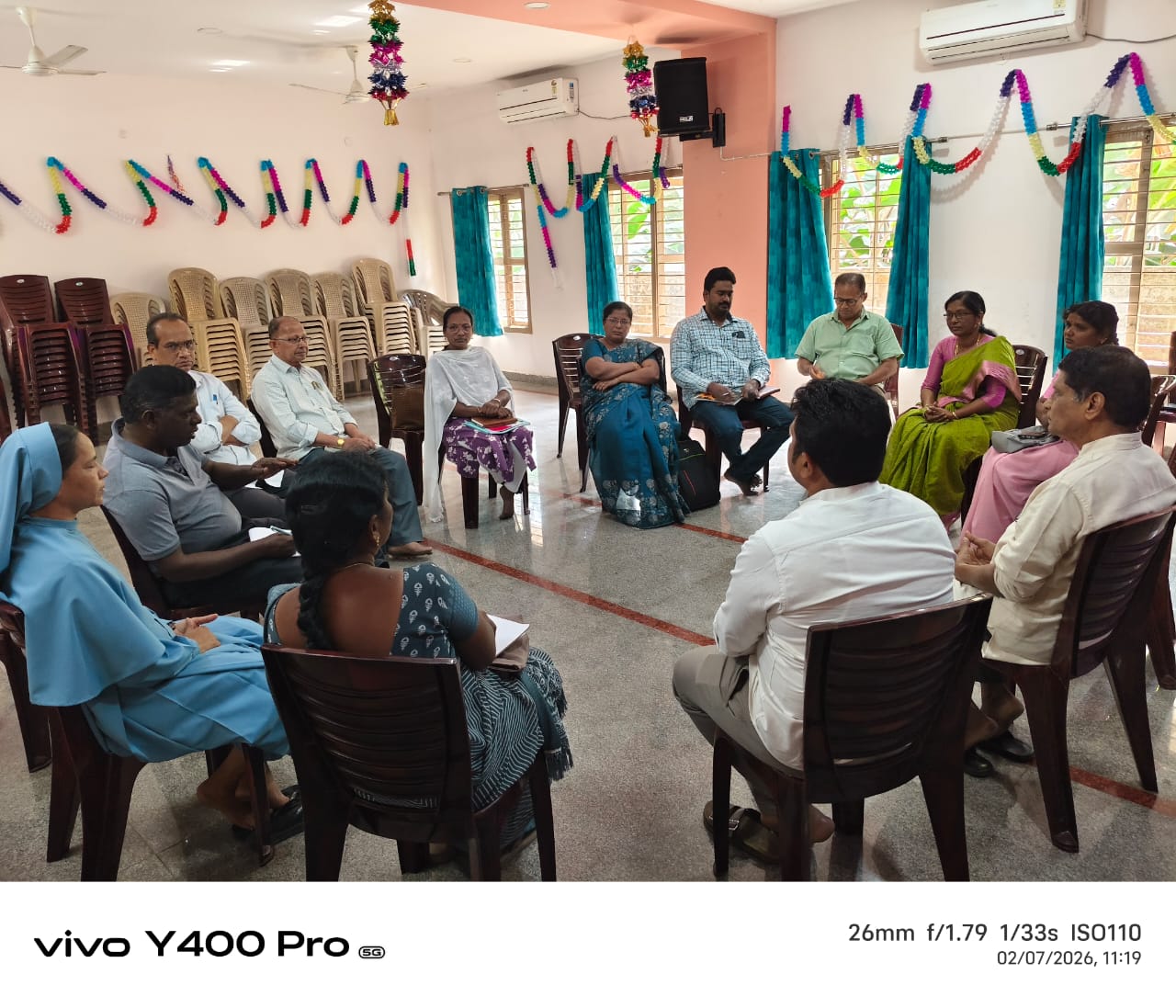
The Annual Review cum Planning Meeting of the Educative Pastoral Council (EPC) and the Salesian Educative Pastoral Plan (SEPP) was held on 7 February 2026 at PARA. The meeting began with the recitation of the Preamble of the Indian Constitution, reaffirming the participants’ commitment to justice, liberty, equality, and fraternity.
A short reflection based on the story of a camel in a zoo invited participants to think about the situation of marginalized communities. Although the Constitution guarantees rights and freedom, many people still remain unable to access these rights. The reflection reminded the participants that their mission is to help people move toward dignity, freedom, and empowerment.
The gathering was welcomed by Fr. Simaharayulu, Associate Director of PARA, who highlighted the importance of collaborative planning for the welfare of marginalized communities.
Key Sessions
The first session, led by Fr. T. D. John, focused on understanding EPC within the framework of synodality. He encouraged participants to reflect on their role in building a society where people can live with dignity. He emphasized that true change begins with a transformation of attitudes and should be measured not by numbers but by the positive transformation in people’s lives. He also explained the identity of PARA through its Salesian, educative, and pastoral dimensions.
Fr. John highlighted the Preventive System of Don Bosco, based on three pillars: reason, religion, and loving kindness. When practiced together, these principles promote peace and harmony in society. He also spoke about three levels of peace: peace keeping, peace making, and peace building.
The second session introduced the Salesian Educative Pastoral Council (SEPC) as a participatory body that coordinates the educational and pastoral mission of Salesian institutions. It promotes the integral formation of youth, especially the poor and marginalized, through collaboration with teachers, parents, communities, and partners.
Annual Report and Priorities
The annual report was presented by Mr. Ramesh, highlighting activities carried out during the year under the five dimensions of SEPP: Education to Faith, Education and Culture, Groups and Social Experiences, Vocational Guidance, and Caring for Our Common Home.
Later, Fr. Simaharayulu presented the Province–House priorities, which include evangelization of youth, empowerment of marginalized communities, promotion of livelihood opportunities, and strengthening social communication.
Future Plans
Participants suggested several initiatives for the coming year, particularly for marginalized communities in the Konaseema region. These include starting tuition centres, promoting Open School education for women and girls, organizing youth vocational guidance programs, encouraging community leadership, and implementing environmental protection initiatives.
Special focus was also given to identifying migrant workers’ locations, strengthening follow-up programs for children under the Education Care and Hope initiative, and establishing a monitoring cell at PARA to track government schemes and social issues.
The meeting concluded with a renewed commitment to strengthen the Salesian Educative Pastoral mission by promoting education, empowerment, faith formation, and care for creation, especially among youth and marginalized communities.