
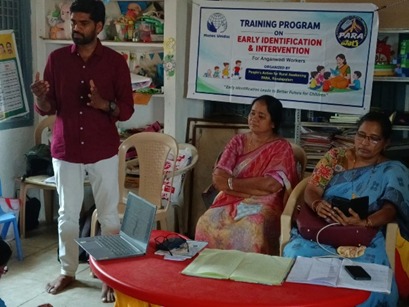
The training program on “Early Identification and Interventions to Anganwadi Workers (ICDS)” was successfully conducted on 30 March 2026 at Penikeru Anganwadi Centre in Narsipudi Sector, Alamuru Mandal. The program was organized by People’s Action for Rural Awakening (PARA) under the leadership of Badugu Mahima Rao, CBR Coordinator, with support from Manos Unidas. A total of 26 Anganwadi Teachers actively participated in the training, representing the ICDS sector of the region. The session aimed to strengthen grassroots-level capacity in addressing developmental challenges among children.
The primary objective of the training was to enhance the ability of Anganwadi Workers to identify developmental delays and disabilities at an early stage, particularly among children below three years of age. The program focused on equipping participants with practical knowledge and skills to recognize early warning signs, thereby ensuring timely intervention. Additionally, the training emphasized improving coordination between ICDS functionaries and voluntary organizations to provide comprehensive support systems for children with disabilities.
In his keynote address, Badugu Mahima Rao stressed that early identification plays a critical role in reducing the severity of disabilities and improving long-term developmental outcomes. He highlighted that Anganwadi Workers serve as the first point of contact at the community level and therefore carry significant responsibility. The session included detailed explanations of various types of disabilities, their early symptoms, and simple, practical identification methods that can be applied at the Anganwadi level. His address reinforced the importance of proactive engagement and regular monitoring of children’s growth and development.
The resource person, Badugu Subbayamma, provided an in-depth session on the support systems available for persons with disabilities. She explained various government welfare schemes, including provisions related to healthcare, inclusive education, special education services, and social security benefits such as pensions. She also elaborated on the 21 categories of disabilities recognized under the Rights of Persons with Disabilities Act, 2016, helping participants understand the legal framework. Furthermore, she guided Anganwadi Workers on how to assist families in accessing these services effectively, ensuring that eligible beneficiaries receive timely support.
The program was further strengthened by the presence of Satyaveni, ICDS Supervisor, who appreciated the initiative and noted that such training programs should be extended to all sectors. She highlighted that the session provided valuable insights and new information to the participants. She assured continued collaboration with PARA and other organizations, emphasizing that issues related to children with disabilities would be promptly addressed through coordinated efforts.
Overall, the training witnessed active engagement from all 26 participants, along with ICDS officials and representatives from PARA. The program concluded on a positive note, emphasizing the importance of early identification, timely intervention, and strong coordination among stakeholders. The training significantly enhanced the knowledge and practical skills of Anganwadi Workers, empowering them to play a more effective and proactive role in promoting inclusive child development at the community level.