
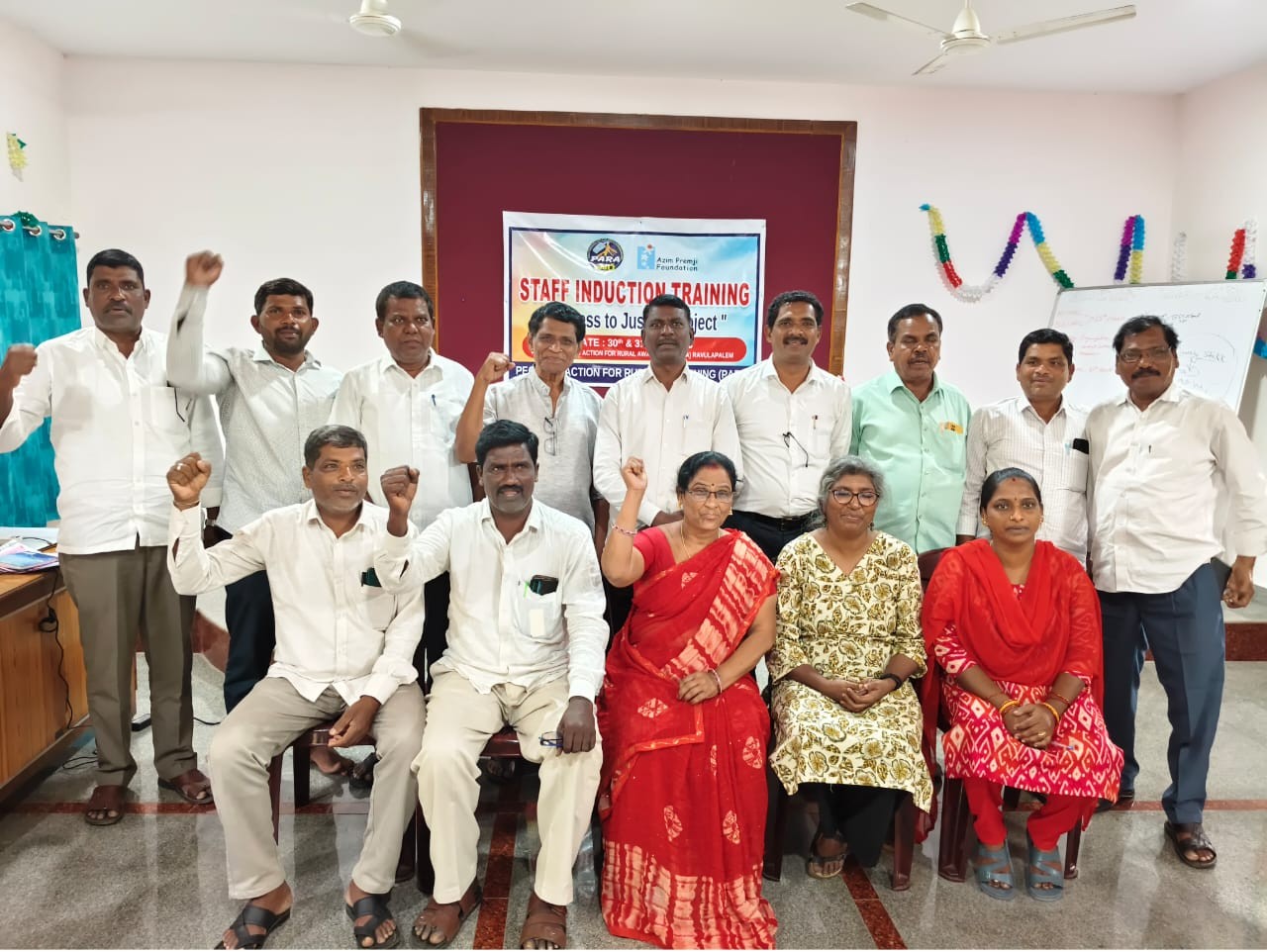
A two-day Staff Induction Training for the Access to Justice Project was conducted on 30–31 January 2025 to orient newly appointed staff members to the organization’s vision, history, and project framework. The training aimed to build a shared understanding of strengthening access to justice for Dalit communities in Andhra Pradesh and Telangana.
The program began with the recitation of the Preamble of the Indian Constitution, reaffirming the values of justice, liberty, equality, and fraternity. A reflective quote from Rabindranath Tagore’s Geetanjali was also shared to set the tone for the training.
Participants then watched a short video titled “The Story of the Camel,” which became a powerful metaphor for reflection. Through discussion, participants highlighted how marginalized communities often possess inherent strengths and constitutional rights but face barriers in accessing opportunities and justice.
During the session, Mr. Chitti Babu, Program Manager, explained that the camel’s features symbolized resilience, the ability to move forward, and protection from adversities. Ms. Rekha Abel emphasized that communities already have the strength to overcome challenges, and the role of the organization is to promote confidence, independence, and empowerment.
A special session by Fr. Thomas Pallithanam traced the history and journey of DBSU over the past 25 years, recalling important milestones such as the cycle rally from Amalapuram to Hyderabad and the organization’s continuous work for Dalit rights despite funding challenges. Regional experiences from Andhra Pradesh and Telangana were also shared by the coordinators.
The training also introduced the Access to Justice Project, which aims to support survivors of caste atrocities in accessing relief, compensation, fair trials, and welfare entitlements. The project plans to document and support 950 atrocity cases, address land rights issues of Dalit families, strengthen Vigilance and Monitoring Committees, and facilitate access to welfare schemes for affected communities.
Roles and responsibilities of the project team were clearly outlined, including the roles of the Project Manager, State Coordinators, District Coordinators, and Mandal Coordinators.
On the second day, the Director formally distributed appointment letters to the staff. The team also prepared a five-month action plan focusing on documentation of cases, fact-finding visits, legal clinics, land rights documentation, and strengthening community monitoring committees.
The Project Manager emphasized the importance of systematic documentation, timely reporting, and financial accountability. A reporting structure was established to ensure smooth coordination among Mandal, District, and State teams.
The induction training concluded with encouraging remarks from the Director and Project Manager. The program helped build a strong foundation for the team by strengthening their understanding of constitutional values, organizational history, and project goals, enabling them to work collectively toward justice and dignity for marginalized communities.