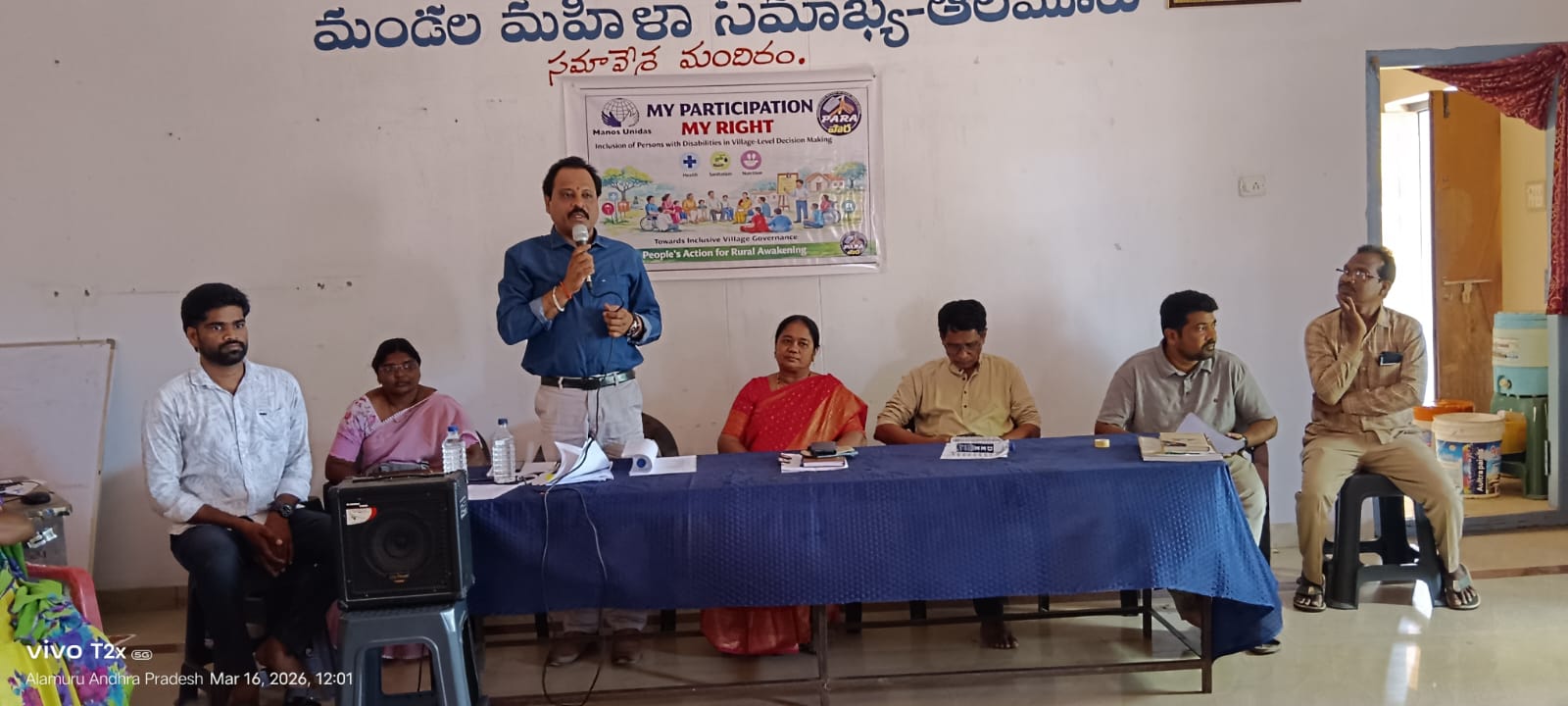
On 16 March 2026, PARA Organization organized a meaningful training and awareness program titled “My Participation – My Right” at the Alamuru Mandal Women’s Federation (VELUGU) Office, Alamuru. The program, coordinated by Mr. Badugu Mahima Rao, CBR Coordinator, focused on strengthening the inclusion and participation of persons with disabilities (PwDs) in village-level governance, particularly in committees related to health, sanitation, and nutrition.
The program brought together a total of 50 participants, of whom 42 were persons with disabilities and 8 were others, including government officials, NGO staff, and the resource person. Participants represented from 18 villages of Alamuru Mandal, making the gathering a diverse and representative platform for dialogue and collective reflection.
The program began on a reflective and rights-based note with the reading of the Preamble of the Constitution of India, reaffirming the shared commitment to equality, dignity, and justice. This set the tone for the day’s discussions, emphasizing that participation in governance is not a privilege but a right for every citizen, including persons with disabilities.
Welcoming the participants, Mr. Badugu Mahima Rao highlighted that meaningful participation of PwDs in village-level committees is essential for ensuring that their voices, needs, and priorities are included in local development planning. He stressed that inclusion is not only the responsibility of persons with disabilities but also of institutions, government systems, and society as a whole. His address created a strong foundation for the discussions that followed.
The session led by Ms. Badugu Subbayamma, resource person added depth and clarity to the program. She explained the key provisions of the Rights of Persons with Disabilities Act, 2016, focusing on social protection, access to healthcare and education, employment opportunities, and most importantly, the right to participate in governance and decision-making processes. Her interaction with participants encouraged them to move from awareness to action, motivating them to claim their rightful space in village committees with confidence.
Building on this, Fr. Thomas Pallithanam, Director of PARA Organization, emphasized the importance of collective leadership and coordination. He encouraged persons with disabilities to see themselves not as beneficiaries but as active contributors and leaders in their communities. His message reinforced the idea that inclusive development is only possible when everyone participates equally.
A significant highlight of the program was the address by the Chief Guest, Mr. Raju, Mandal Parishad Development Officer (MPDO), Alamuru. He appreciated the initiative and acknowledged the importance of ensuring inclusion in governance systems. Importantly, he assured that necessary instructions would be issued to all Panchayats in the Mandal to facilitate the participation of persons with disabilities in village-level committees. This commitment marked a crucial step toward institutionalizing inclusion at the grassroots level.
The program was not limited to speeches but created space for active engagement. Participants openly shared their experiences, challenges, and aspirations regarding their participation in village governance. Many expressed that they had previously been excluded or unaware of their rights, but the program helped them gain clarity and confidence. The presence of other dignitaries, including Fr. Simharayulu (Administrator, PARA), Ms. Durga (Block Coordinator), and Mr. Prakash (DB-Tech Representative), further strengthened the discussions and encouraged participants.
The program concluded with a collective commitment pledge, where participants affirmed their willingness to actively engage in village committees and contribute to community development. This moment reflected a strong sense of unity, self-belief, and shared responsibility among the participants.
Overall, the program was not just an awareness activity but a transformative experience that strengthened the confidence, knowledge, and motivation of persons with disabilities. It helped bridge the gap between rights and practice by connecting community members with institutional support. The assurance given by the MPDO, combined with the increased awareness among participants, indicates a positive shift toward more inclusive and participatory village governance in Alamuru Mandal.